
Designing an IoT device to keep a million people safe at the Netherlands' largest public event


Client: Vodafone Business
Partners: Municipality of Nijmegen, Dutch Police
Industry: Smart Industry / Public Safety
Service: PCB Design, Embedded Software, Network Integration
The largest freely accessible event in the Netherlands: the Four Days Marches in Nijmegen. This year, the event was the setting for an important test for Vodafone Business in collaboration with partner Spinnov, with the question: how can IoT and network slicing contribute to safety? Watch the video for the answer.
Client and Goals
Every July, the Four Days Marches in Nijmegen draws close to a million visitors making it the largest freely accessible event in the Netherlands. Managing crowd safety at that scale is a genuine operational challenge: security guards cover a large area, peak crowds can form rapidly, and when something happens, emergency services need to communicate instantly and reliably even as the network is saturated with a million smartphones.
Vodafone Business wanted to test whether IoT and network slicing could provide a meaningful, practical answer to that challenge. SPINNOV was brought in to design and build the hardware that would make the test possible.
Challenges
Two distinct problems needed solving, and they were related.
The first was visibility. Security guards patrolling a large, crowded event have no fast, reliable way to report a dangerous crowd buildup to a central control room. Calling or texting takes time and attention, and in a noisy, busy environment, there's no guarantee the message gets through clearly or quickly enough to act on. The control room needs an unambiguous, instant signal that a specific location is approaching dangerous density.
The second problem was network reliability at the worst possible moment. The Four Days Marches fills the city. A million visitors means a million devices competing for the same mobile network capacity. Under normal conditions, this causes congestion that degrades call quality and data speeds for everyone, including the emergency services and security personnel who need connectivity most. If the network slows down precisely when crowds are most dangerous, the safety system fails at the point it's needed most.
SPINNOV’s Solution
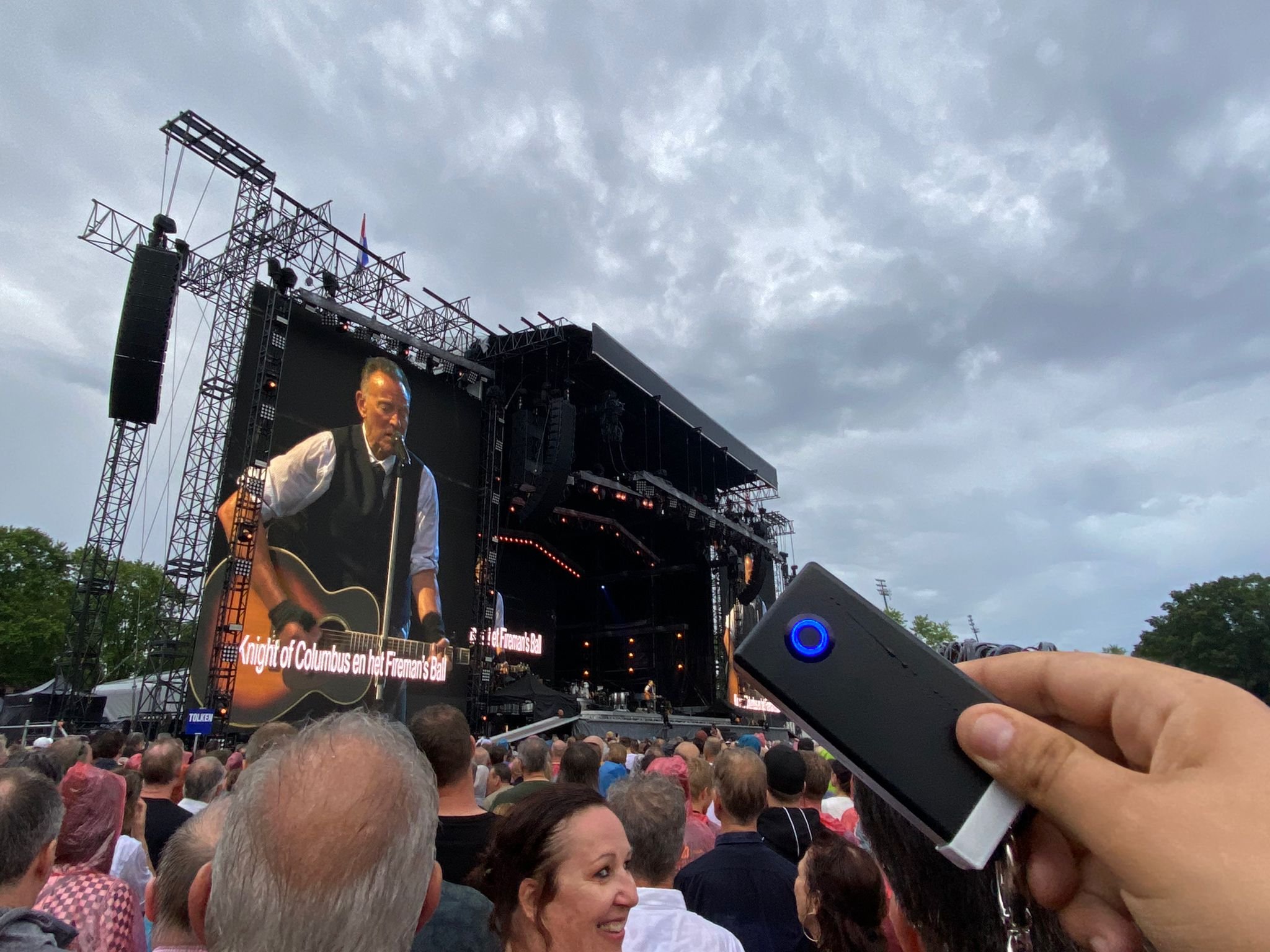
SPINNOV designed and built the Crowd Control Button, a purpose-built IoT device that security guards carried throughout the event. Combined with Vodafone's network slicing infrastructure, the system gave the police control room real-time crowd visibility across the event area and guaranteed communication capacity for safety-critical traffic regardless of general network load. Specifically, we:
Designed the custom PCB for the Crowd Control Button, built for rugged outdoor use during a multi-day public event
Developed the embedded firmware handling button input, GPS positioning, and reliable cellular data transmission
Integrated with Vodafone's network slicing infrastructure to ensure safety-critical communications operated on a reserved, isolated slice of bandwidth
Delivered a system that transmitted precise GPS location and crowd status signals to the police control room with a single button press
Validated the full solution under real event conditions: summer heat, a million concurrent users on the network, and continuous operation across multiple days
1 / Designing the device around the operator
One button, one job, no ambiguity
A security guard managing a crowd situation doesn't have time to navigate an app or compose a message. The Crowd Control Button was designed around a single interaction: press it, and the control room instantly receives the guard's GPS location and a crowd alert. That's it.
This simplicity wasn't an accident, it was the core design constraint. The hardware had to be robust enough to survive days of outdoor use in July heat, operable with one hand while the other is managing the crowd, and reliable enough that a guard can press it without wondering whether it worked. The PCB and firmware were built to those requirements: fast to respond, resilient to interference, and unambiguous in its confirmation that the signal was sent.
2 / Network slicing, a reserved lane for safety traffic
Solving congestion before it becomes a crisis
Standard mobile networks are shared infrastructure. When a million people gather in one place, everyone's signal competes for the same capacity. This is manageable for social media and streaming, but unacceptable for emergency communications where a five-second delay can change an outcome.
Vodafone Business addressed this through network slicing: carving a dedicated, isolated segment of bandwidth, a private lane on the shared network, reserved exclusively for the event's safety communications. Traffic on this slice is completely unaffected by congestion on the rest of the network. The Crowd Control Buttons, the police control room communications, and emergency service coordination all operated on this reserved slice throughout the event.
SPINNOV integrated the devices directly with this sliced network infrastructure, ensuring every button press reached the control room with the speed and reliability the system required, regardless of what was happening on the wider network at the same moment.
3 / Real-world validation at scale
Testing where it counts
4 / Final deliverables
A validated proof of concept for IoT-enabled public safety
Lab testing tells you a device works. A million-person public event tells you whether it actually holds up.
The Four Days Marches provided conditions that are almost impossible to replicate artificially: extreme cellular congestion, continuous outdoor operation in summer heat, real security personnel under genuine operational pressure, and actual consequences if the system failed. The test confirmed that the combination of the IoT devices and Vodafone's network slicing delivered consistent, reliable performance throughout.
When crowd alerts were triggered, matrix signs at key entry points directed visitors away from congested areas. When escalation was needed, emergency services received the call and the location through the same reserved network slice. without competing with the background traffic of a million mobile users.
The Four Days Marches pilot demonstrated something that matters well beyond one event: that IoT devices combined with reserved network infrastructure can give security and emergency services reliable situational awareness and communications exactly when and where the network is under the most pressure.