

Redesigning the control device that lets welders teach a cobot arm


Client: WeCobot
Industry: Smart Industry / Industrial Automation
Service: Product Design, PCB Design, Embedded Software
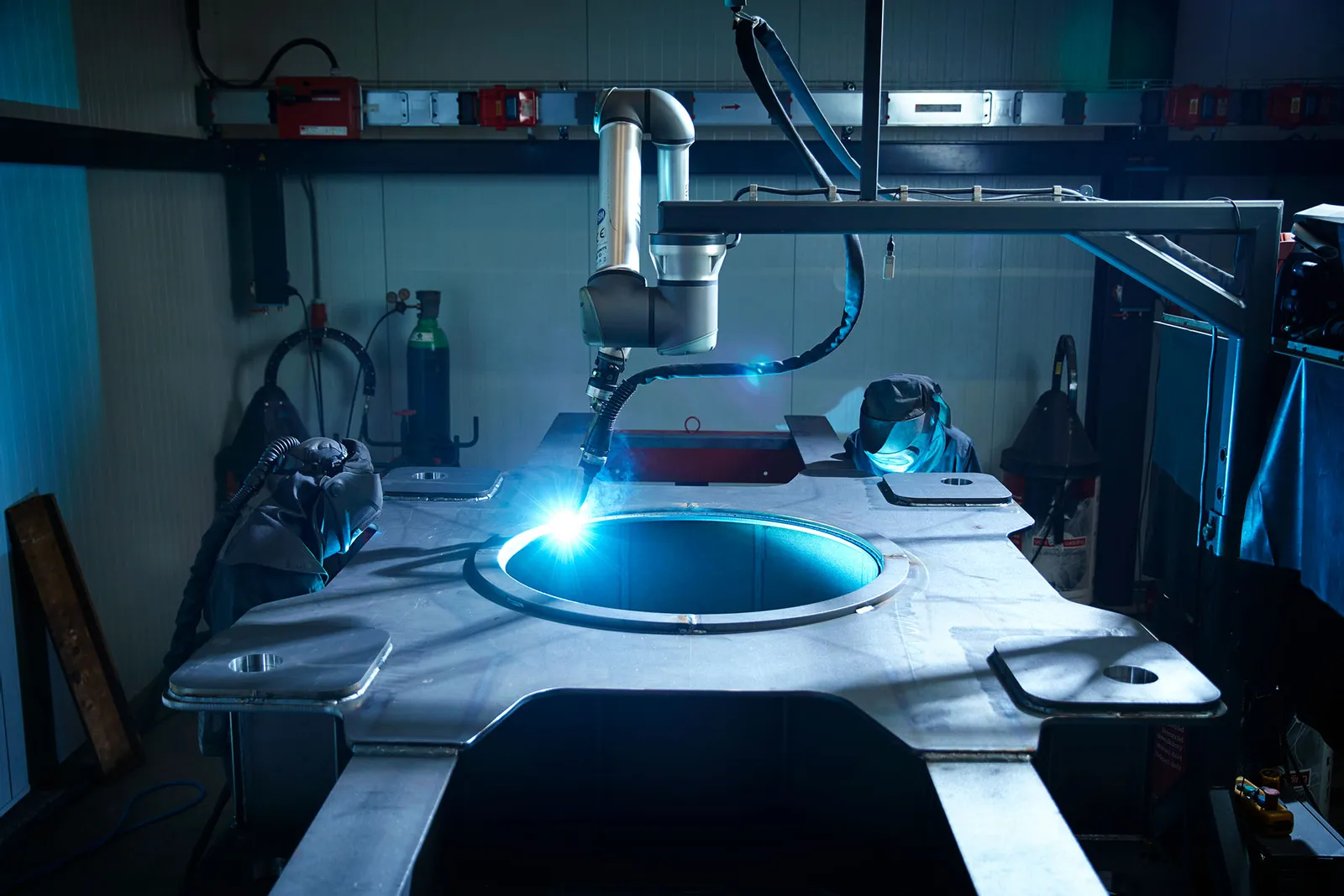
WeCobot specializes in plug-and-play collaborative robot (cobot) welding solutions that make welding processes faster, safer, and more efficient. They provide cobot welding systems with both hardware and intuitive software, enabling welders to automate tasks without requiring programming expertise.
Client and Goals
WeCobot builds plug-and-play collaborative robot welding systems, cobots that professional welders can operate and teach without needing programming expertise. Their philosophy is that automation should work for the welder, not the other way around. The OneRing is the physical interface that makes this possible: a handheld control device mounted on the robot arm that lets an operator guide the cobot, trigger welds, and receive feedback in real time. WeCobot assigned SPINNOV to replace their existing device, the youRing, with something more durable, more ergonomic, and more reliable under the demanding conditions of an industrial welding environment.
Challenges
Replacing an existing product that users already know and depend on is a particular kind of design challenge. The functionality had to be preserved, operators who had learned the youRing needed to feel immediately at home with the OneRing, while improving the things that weren't working well enough. The youRing had served its purpose, but WeCobot needed a device built to last in a harsher environment and handle a longer service life.
The welding context sets unusually demanding requirements. The device lives on a robot arm, which means it absorbs vibration, is handled repeatedly throughout a shift, and operates in an environment with heat, spatter, and electromagnetic interference from the welding process itself. The casing had to be robust without being unwieldy, and the electronics inside had to remain reliable despite the interference conditions that are normal on a welding floor.
At the same time, usability couldn't be compromised in the name of ruggedness. A welder operating a cobot needs clear, immediate feedback, knowing whether a command was received, whether the robot is ready, whether a weld was triggered successfully. Ambiguous feedback in that context means stopping, checking, and losing time. The interface had to be intuitive enough that the device disappeared into the workflow rather than becoming a friction point in it.
SPINNOV’s Role
SPINNOV designed and delivered the OneRing from concept to production, a purpose-built control device that improves on the youRing in durability, ergonomics, and feedback clarity while maintaining the operational familiarity WeCobot's customers expected. Specifically, we:
Designed the aluminum casing with an integrated LED diffuser, combining durability with clean, visible feedback in bright industrial environments
Engineered the PCB for reliable operation under the vibration, heat, and EMI conditions of a welding floor
Designed the control interface, button layout, LED ring, and buzzer, to give operators unambiguous, real-time feedback on device and robot status
Optimised ergonomics and mounting for comfortable use on a robot arm during repeated, hands-on welding sessions
Developed the embedded firmware managing input handling, feedback logic, and robot arm communication
Delivered production-ready hardware and documentation for manufacturing at scale

1 / Starting with the operator, not the enclosure
What a welder actually needs from a control device
Before designing anything, we spent time understanding how the youRing was actually used on the floor, where it frustrated operators, where it worked well, and what conditions it was exposed to during a normal shift. WeCobot's customers are professional welders, not technologists. They use the device continuously, under time pressure, often in noisy and visually busy environments.
Three things emerged from that understanding as the defining requirements for the OneRing. First, the feedback had to be unambiguous at a glance, operators shouldn't have to look closely at a small indicator to know whether the robot received a command. The LED ring, visible from multiple angles and diffused to avoid hotspots, was the answer to that. Second, the button layout had to work with a gloved hand, and the button actuation had to feel positive and deliberate, not something that could be accidentally triggered or that left any doubt about whether it registered. Third, the buzzer needed to cut through welding floor noise to serve as a meaningful audio cue rather than background noise.
2 / Designing for the welding environment
Aluminum, precision engineering, and EMI resilience
The choice of aluminum for the casing was both functional and intentional. Aluminum dissipates heat well, handles the mechanical abuse of an industrial environment, and gives the device a quality feel that matches the professional context it's used in. It also provides shielding against electromagnetic interference, an important consideration given the high-current, high-frequency fields generated by the welding process itself.
The PCB design had to work reliably inside that environment. Vibration from the robot arm, thermal cycling from proximity to the weld, and the EMI conditions on a welding floor all had to be accounted for in the layout and component selection. We applied conservative design margins and validated the electronics against the mechanical and electromagnetic conditions the device would actually encounter.
The LED diffuser was engineered into the aluminum housing to distribute light evenly around the ring without visible hotspots or dark patches, small details that matter when the device is used all day and operators rely on it as an at-a-glance status indicator.
3 / Final deliverables
A production-ready replacement, built to outlast its predecessor
The OneRing replaced the youRing as the standard control interface across WeCobot's cobot welding systems, a device that meets welders where they are, survives the environment they work in, and lets the cobot do its job without the controller getting in the way.